Rosmarinus officinalis, commonly known as
rosemary, is a woody,
perennial herb with fragrant,
evergreen, needle-like leaves and white, pink, purple, or blue flowers,
native to the Mediterranean region.
It is a member of the mint family
Lamiaceae, which includes many other herbs. The name "rosemary" derives from the
Latin for "dew" (
ros) and "sea" (
marinus), or "dew of the sea".
[2] The plant is also sometimes called
anthos, from the ancient Greek word ἄνθος, meaning "flower".
[3] Rosemary has a
fibrous root system.
Taxonomy[edit]
Description[edit]
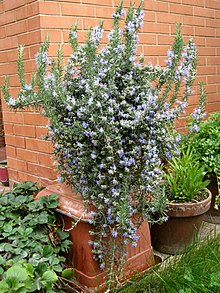
Rosmarinus officinalis prostratus
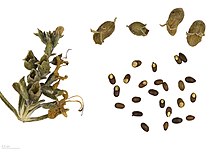
Rosmarinus officinalis –
MHNT
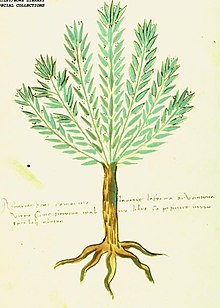
Rosemary illustration from an Italian
herbal,
circa 1500
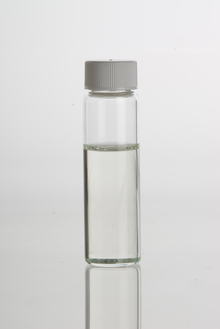
Rosemary (
Rosmarinus officinalis) essential oil
Rosemary is an aromatic evergreen shrub with leaves similar to
hemlock needles. It is native to the Mediterranean and Asia, but is reasonably hardy in cool climates. It can withstand droughts, surviving a severe lack of water for lengthy periods.
[5]Forms range from upright to trailing; the upright forms can reach 1.5 m (5 ft) tall, rarely 2 m (6 ft 7 in). The leaves are evergreen, 2–4 cm (0.8–1.6 in) long and 2–5 mm broad, green above, and white below, with dense, short, woolly hair. The plant flowers in spring and summer in
temperate climates, but the plants can be in constant bloom in warm climates; flowers are white, pink, purple or deep blue.
[6] Rosemary also has a tendency to flower outside its normal flowering season; it has been known to flower as late as early December, and as early as mid-February (in the northern hemisphere).
[7]
Mythology[edit]
According to
myth, the
Virgin Mary is said to have spread her blue cloak over a white-blossomed rosemary bush when she was resting, and the flowers turned blue. The shrub then became known as the "Rose of Mary".
[8] Rosemary was considered sacred to ancient Egyptians, Romans and Greeks.
[9]
Upon cultivation, the leaves, twigs, and flowering apices are extracted for use.
[9] Rosemary is used as a decorative plant in gardens where it may have
pest control effects. The leaves are used to flavor various foods, such as
stuffings and roast meats.
Cultivation[edit]
Since it is attractive and drought-tolerant, rosemary is used as an ornamental plant in gardens and for
xeriscape landscaping, especially in regions of
Mediterranean climate. It is considered easy to grow and pest-resistant. Rosemary can grow quite large and retain attractiveness for many years, can be pruned into formal shapes and low hedges, and has been used for
topiary. It is easily grown in pots. The
groundcover cultivars spread widely, with a dense and durable texture.
Rosemary grows on friable loam soil with good drainage in an open, sunny position. It will not withstand waterlogging and some varieties are susceptible to frost. It grows best in neutral to alkaline conditions (pH 7–7.8) with average fertility. It can be propagated from an existing plant by clipping a shoot (from a soft new growth) 10–15 cm (4–6 in) long, stripping a few leaves from the bottom, and planting it directly into soil.
Cultivars[edit]
Numerous
cultivars have been selected for garden use. The following are frequently sold:
- 'Albus' – white flowers
- 'Arp' – leaves light green, lemon-scented and especially cold-hardy
- 'Aureus' – leaves speckled yellow
- 'Benenden Blue' – leaves narrow, dark green
- 'Blue Boy' – dwarf, small leaves
- 'Blue Rain' – pink flowers
- 'Golden Rain' – leaves green, with yellow streaks
- 'Gold Dust' -dark green leaves, with golden streaks but stronger than 'Golden Rain'
- 'Haifa' – low and small, white flowers
- 'Irene' – low and lax, trailing, intense blue flowers
- 'Lockwood de Forest' – procumbent selection from 'Tuscan Blue'
- 'Ken Taylor' – shrubby
- 'Majorica Pink' – pink flowers
- 'Miss Jessop's Upright' – distinctive tall fastigiate form, with wider leaves.
- 'Pinkie' – pink flowers
- 'Prostratus' – lower groundcover
- 'Pyramidalis' (or 'Erectus') – fastigate form, pale blue flowers
- 'Remembrance' (or 'Gallipoli') – taken from the Gallipoli Peninsula[10]
- 'Roseus' – pink flowers
- 'Salem' – pale blue flowers, cold-hardy similar to 'Arp'
- 'Severn Sea' – spreading, low-growing, with arching branches, flowers deep violet
- 'Sudbury Blue' – blue flowers
- 'Tuscan Blue' – traditional robust upright form
- 'Wilma's Gold' – yellow leaves
Culinary use[edit]
Rosemary leaves are used as a flavoring in foods such as stuffings and roast lamb, pork, chicken and turkey. Fresh or dried leaves are used in traditional
Mediterranean cuisine. They have a bitter,
astringent taste and a characteristic
aroma which complements many cooked foods.
Herbal tea can be made from the leaves. When roasted with meats or vegetables, the leaves impart a
mustard-like aroma with an additional fragrance of
charred wood compatible with
barbecued foods.
Fragrance[edit]
Rosemary oil is used for purposes of fragrant bodily perfumes or to emit an aroma into a room. It is also burnt as incense, and used in shampoos and cleaning products.
Phytochemicals and traditional medicine[edit]
In
traditional medicine, extracts and
essential oil from flowers and leaves are used in the belief they may be useful to treat a variety of disorders.
[18] Rosemary essential oil contains 10-20% camphor,
[19] though the chemical composition can vary greatly between different samples, according to
in vitro studies.
[20]
Folklore and customs[edit]
In the
Middle Ages, rosemary was associated with wedding ceremonies. The bride would wear a rosemary headpiece and the groom and wedding guests would all wear a sprig of rosemary. From this association with weddings, rosemary was thought to be a love charm.
[21]
Rosemary has long had a popular reputation for improving memory.
The Guardian reported in 2017 that sales of Rosemary oil to students in the
UK studying for exams had skyrocketed because of Rosemary's perceived benefits to memory.
[22]
The plant has also been used as a symbol for remembrance during war commemorations and funerals in Europe and Australia.
[23] Mourners would throw it into graves as a symbol of remembrance for the dead. In
Shakespeare's Hamlet,
Ophelia says, "There's rosemary, that's for remembrance." (Hamlet, iv. 5.) In Australia, sprigs of rosemary are worn on
ANZAC Day and sometimes
Remembrance Day to signify remembrance; the herb grows wild on the
Gallipoli Peninsula.
[23]
Hungary water was first prepared for the Queen of Hungary
Elisabeth of Poland to " ... renovate vitality of paralyzed limbs ... " and to treat
gout. It was used externally and prepared by mixing fresh rosemary tops into spirits of wine.
[24] Don Quixote (Part One, Chapter XVII) mixes it in his recipe of the miraculous balm of
Fierabras.
[25]


.jpg)

.jpg)


.JPG)