Cinchona officinalis (Cinchonine) dược liệu kháng A549
From Wikipedia, the free encyclopedia
| Quinine bark | |
|---|---|
.jpg) | |
| Scientific classification | |
| Kingdom: | Plantae |
| (unranked): | Angiosperms |
| (unranked): | Eudicots |
| (unranked): | Asterids |
| Order: | Gentianales |
| Family: | Rubiaceae |
| Subfamily: | Cinchonoideae |
| Tribe: | Cinchoneae |
| Genus: | Cinchona |
| Species: | C. officinalis |
| Binomial name | |
| Cinchona officinalis L. | |
| Synonyms | |
Cinchona officinalis is a South American tree in the Rubiaceae family. It is native to wet montane forests in Colombia, Ecuador, Peru and Bolivia, between 1600–2700 meters above sea level.[1][2]
Contents
[hide]Description[edit]
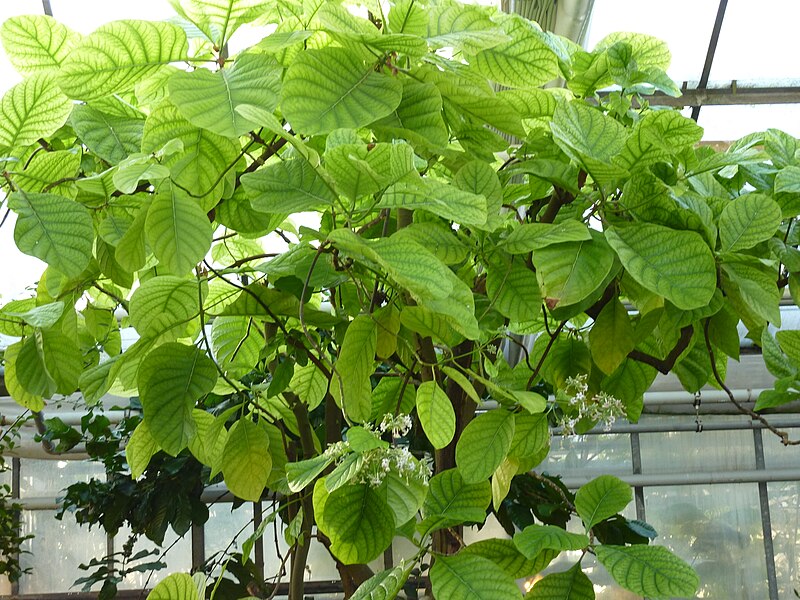
Cinchona officinalis is a shrub or tree with rugose bark and branchlets covered in minute hairs. Stipules lanceolate or oblong, acute or obtuse, glabrous. Leaves lanceolate to elliptic or ovate, usually about 10 cm. long and 3.5–4 cm. wide; acute, acuminate, or obtuse tip; base rounded to attenuate; coriaceous, glabrous above and often lustrous; glabrous beneath or puberulent or short-pilose, especially on the veins. Inflorescences in terminal panicles, many-flowered; hypanthium with short coarse hairs; reddish calyx, glabrous or nearly so, with triangular lobes; pink or red corolla, sericeous, the lobes ovate, acute, the corolla tube being about 1 cm. long. Fruit and oblong capsule, 1.5–2 cm. long, almost glabrous.[1][3]
Vernacular names[edit]
English: quinine, red cinchona, cinchona bark, Jesuit’s bark, loxa bark, Jesuit’s powder, countess powder, Peruvian bark.[4][5]
Uses[edit]
Cinchona officinalis is a medicinal plant, one of several Cinchona species used for the production of quinine, which is an anti-fever agent. It is especially useful in the prevention and treatment of malaria. Other alkaloids that are extracted from this tree include cinchonine, cinchonidine and quinidine.[4]