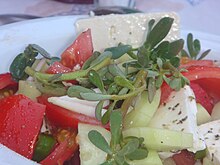
Greek salad with purslane
Portulaca oleracea (
common purslane, also known as
verdolaga,
little hogweed,
red root,
pursley,
بقله , فرفحينا) is an
annual succulent in the family
Portulacaceae, which may reach 40 centimetres (16 in) in height.
Approximately forty cultivars are currently grown.
[1]
Distribution[edit]
It has an extensive distribution, assumed to be mostly
anthropogenic,
[2] throughout the Old World extending from
North Africaand Southern
Europe through the
Middle East and the
Indian Subcontinent to
Malesia and
Australasia. The species status in the New World is uncertain: in general, it is considered an exotic weed, however, there is evidence that the species was in
Crawford Lake deposits (
Ontario) in 1350-1539, suggesting that it reached North America in the
pre-Columbian era. Scientists suggested that the plant was already eaten by
native Americans, who spread its seeds. How it reached the New World is currently unknown.
[3] It is naturalised elsewhere, and in some regions is considered an introduced
weed.
Description[edit]
It has smooth, reddish, mostly prostrate stems and alternate
leaves clustered at stem joints and ends. The yellow
flowers have five regular parts and are up to 6 millimetres (0.24 in) wide. Depending upon rainfall, the flowers appear at any time during the year. The flowers open singly at the center of the
leaf cluster for only a few hours on sunny mornings. Seeds are formed in a tiny pod, which opens when the seeds are mature. Purslane has a
taproot with fibrous secondary roots and is able to tolerate poor
compacted soils and drought.
History[edit]
Widely used in East Mediterranean countries, archaeobotanical finds are common at many
prehistoric sites. In
historiccontexts, seeds have been retrieved from a
protogeometric layer in
Kastanas, as well as from the
Samian Heraion dating to seventh century BC. In the fourth century BC,
Theophrastus names purslane,
andrákhne (ἀνδράχνη), as one of the several summer pot herbs that must be sown in April (
H.P 7.1.2).
[4] As
Portulaca it figures in the long list of comestibles enjoyed by the Milanese given by
Bonvesin de la Riva in his "Marvels of Milan" (1288).
[5]
In antiquity, its healing properties were thought so reliable that
Pliny the Elder advised wearing the plant as an amulet to expel all evil (
Natural History 20.210).
[4]
A common plant in parts of India, purslane is known as sanhti, punarva, paruppu keerai, "gangabayala kura", or kulfa.
Culinary[edit]
Although purslane is considered a
weed in the United States, it may be eaten as a
leaf vegetable.
[6] It has a slightly sour and salty taste and is eaten throughout much of Europe, the Middle East, Asia, and Mexico.
[1][7] The stems, leaves and flower buds are all edible. Purslane may be used fresh as a
salad,
stir-fried, or cooked as
spinach is, and because of its
mucilaginous quality it also is suitable for
soups and
stews. The sour taste is due to
oxalic and
malic acid, the latter of which is produced through the
crassulacean acid metabolism (CAM) pathway that is seen in many
xerophytes (plants living in dry conditions), and is at its highest when the plant is harvested in the early morning.
[8]
Australian Aborigines use the seeds of purslane to make
seedcakes. Greeks, who call it
andrakla (αντράκλα) or
glystrida(γλυστρίδα), use the leaves and the stems with
feta cheese,
tomato,
onion,
garlic,
oregano, and
olive oil. They add it in salads, boil it, or add it to casseroled chicken. In Turkey, besides being used in salads and in baked pastries, it is cooked as a vegetable similar to spinach. Similarly, in
Egypt, it is known as
reglah رجلة and cooked as a vegetable stew. Called
Bakleh in Syria and Lebanon, is eaten raw in a famous salad called
fattoush, and cooked as a garniture in
fatayeh(triangular salted pastries)
. In
Albania, known as
burdullak, it also is used as a vegetable similar to spinach, mostly simmered and served in olive oil dressing, or mixed with other ingredients as a filling for dough layers of
byrek. In the south of Portugal (
Alentejo),
baldroegas are used as a soup ingredient. In Pakistan, it is known as
qulfa and is cooked as in stews along with lentils, similarly to spinach, or in a mixed green stew.
Traditional medicine[edit]

Portulaca oleracea showing blooms
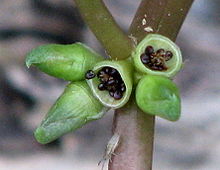
Seed pods, closed and open, revealing the seeds
Use is contraindicated during pregnancy and for those with cold and weak digestion.
[10]
Companion plant[edit]
As a
companion plant, purslane provides ground cover to create a humid microclimate for nearby plants, stabilising ground moisture. Its deep roots bring up moisture and nutrients that those plants can use, and some, including corn, will follow purslane roots down through harder soil that they cannot penetrate on their own (
ecological facilitation). It is known as a
beneficial weed in places that do not already grow it as a crop in its own right.
Nutrition[edit]

Although often identified as a "weed", purslane is a vegetable rich in omega-3 fatty acids and antioxidants, a cultivar, sativa, is shown here being grown in a ceramic pot

portulaca oleracea under artificial lights
Also present are two types of
betalain alkaloid pigments, the reddish betacyanins (visible in the coloration of the stems) and the yellow
betaxanthins (noticeable in the flowers and in the slight yellowish cast of the leaves). Both of these pigment types are potent antioxidants and have been found to have antimutagenic properties in laboratory studies.
[13]
Cooked vs. raw[edit]
100 grams of fresh purslane leaves contain 300 to 400 mg of
alpha-linolenic acid.
[12]One cup (250 ml) of cooked leaves contains 90 mg of calcium, 561 mg of potassium, and more than 2,000 IUs of vitamin A.
A half-cup of raw purslane leaves contains as much as 910 mg of
oxalate, a compound implicated in the formation of
kidney stones. Cooking purslane reduces overall soluble oxalate content by 27%.
[14]
Morning harvest vs. afternoon[edit]
When water is abundant, purslane performs photosynthesis mostly by
C4 carbon fixation, which is more widespread in nature. When stressed by low availability of water, however, purslane, which has evolved in hot and dry environments, switches to photosynthesis using an alternative pathway,
crassulacean acid metabolism (the CAM pathway). At night its leaves trap carbon dioxide, which is converted into
malic acid (the souring principle of apples), and, in the day, the malic acid is converted into glucose. When harvested in the early morning, the leaves have ten times the malic acid content as when harvested in the late afternoon, and thus have a significantly more tangy taste. (
Opuntia cacti, which are eaten as a vegetable, "nopales", in Mexican cuisine, also employ the CAM pathway and are similarly best harvested in the early morning, though the pickled nopales sold commercially have citric or malic acids added to the pickling liquid.)
Chemical constituents[edit]
Chemical constituents include
noradrenaline, calcium salts,
dopamine,
L-DOPA,
malic acid,
citric acid,
glutamic acid,
asparagic acid,
nicotinic acid,
alanine,
glucose,
fructose, and
sucrose.
[10]
In popular culture[edit]
- Purslane also finds mention in a translation of the Bible as a repulsive food. Job's question in Job 6:6 is translated in the Revised Standard Version as, "Can that which is tasteless be eaten without salt or is there any taste in the slime of the purslane?" whereas the King James Version translates this verse as "Can that which is unsavoury be eaten without salt? Or is there any taste in the white of an egg?"
- The name verdolaga, associated with the plant that grows in South America, is a nickname for football clubs with green-white schemes in their uniforms, such as Colombia's Atletico Nacional and Argentina's Ferrocarril Oeste.
See also[edit]


