Algae
Fossil range: Mesoproterozoic–present[1]
|
|---|
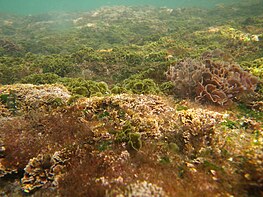
A variety of algae growing on the sea bed in shallow waters
|
| Scientific classification |
|---|
|
|
| Included groups |
|---|
|
|
| Excluded groups |
|---|
|
|
Algae (
; singular
alga ) is an informal term for a large, diverse group of
photosynthetic organismswhich are not necessarily closely related, and is thus
polyphyletic. Included organisms range from
unicellular genera, such as
Chlorella and the
diatoms, to
multicellular forms, such as the
giant kelp, a large
brown alga which may grow up to 50 m in length. Most are aquatic and
autotrophic and lack many of the distinct cell and tissue types, such as
stomata,
xylem, and
phloem, which are found in
land plants. The largest and most complex marine algae are called
seaweeds, while the most complex freshwater forms are the
Charophyta, a
division of green algae which includes, for example,
Spirogyra and the
stoneworts.
No definition of algae is generally accepted. One definition is that algae "have
chlorophyll as their primary photosynthetic pigment and lack a sterile covering of cells around their reproductive cells".
[2] Some authors exclude all prokaryotes
[3]thus do not consider
cyanobacteria (blue-green algae) as algae.
[4]
Algae constitute a polyphyletic group
[3] since they do not include a common ancestor, and although their plastids seem to have a single origin, from cyanobacteria,
[5] they were acquired in different ways.
Green algae are examples of algae that have primary chloroplasts derived from
endosymbiotic cyanobacteria.
Diatoms and brown algae are examples of algae with secondary chloroplasts derived from an
endosymbiotic red alga.
[6]
Algae lack the various structures that characterize land plants, such as the phyllids (leaf-like structures) of
bryophytes,
rhizoids in
nonvascular plants, and the
roots,
leaves, and other
organs found in
tracheophytes (
vascular plants). Most are
phototrophic, although some are
mixotrophic, deriving energy both from photosynthesis and uptake of organic carbon either by
osmotrophy,
myzotrophy, or
phagotrophy. Some unicellular species of
green algae, many
golden algae,
euglenids,
dinoflagellates, and other algae have become
heterotrophs (also called colorless or apochlorotic algae), sometimes parasitic, relying entirely on external energy sources and have limited or no photosynthetic apparatus.
[8][9][10]Some other heterotrophic organisms, such as the
apicomplexans, are also derived from cells whose ancestors possessed plastids, but are not traditionally considered as algae. Algae have photosynthetic machinery ultimately derived from
cyanobacteria that produce
oxygen as a by-product of photosynthesis, unlike other photosynthetic bacteria such as
purple and
green sulfur bacteria. Fossilized filamentous algae from the
Vindhya basin have been dated back to 1.6 to 1.7 billion years ago.
[11]
Etymology and study[edit]
The singular
alga is the Latin word for "seaweed" and retains that meaning in English.
[12] The
etymology is obscure. Although some speculate that it is related to Latin
algēre, "be cold",
[13] no reason is known to associate seaweed with temperature. A more likely source is
alliga, "binding, entwining".
[14]
The
Ancient Greek word for seaweed was φῦκος (
phŷcos), which could mean either the seaweed (probably red algae) or a red dye derived from it. The Latinization,
fūcus, meant primarily the cosmetic rouge. The etymology is uncertain, but a strong candidate has long been some word related to the Biblical פוך (
pūk), "paint" (if not that word itself), a cosmetic eye-shadow used by the ancient Egyptians and other inhabitants of the eastern Mediterranean. It could be any color: black, red, green, or blue.
[15]
Accordingly, the modern study of marine and freshwater algae is called either
phycology or algology, depending on whether the Greek or Latin root is used. The name
Fucus appears in a number of
taxa.
Classification[edit]
Most algae contain
chloroplasts that are similar in structure to cyanobacteria. Chloroplasts contain circular
DNA like that in cyanobacteria and presumably represent reduced endosymbiotic cyanobacteria. However, the exact origin of the chloroplasts is different among separate lineages of algae, reflecting their acquisition during different endosymbiotic events. The table below describes the composition of the three major groups of algae. Their lineage relationships are shown in the figure in the upper right. Many of these groups contain some members that are no longer photosynthetic. Some retain plastids, but not chloroplasts, while others have lost plastids entirely.
| Supergroup affiliation | Members | Endosymbiont | Summary |
|---|
Primoplantae/
Archaeplastida |
| Cyanobacteria | These algae have 'primary' chloroplasts, i.e. the chloroplasts are surrounded by two membranes and probably developed through a single endosymbiotic event. The chloroplasts of red algae have chlorophylls a and c (often), and phycobilins, while those of green algae have chloroplasts with chlorophyll a and b without phycobilins. Land plants are pigmented similarly to green algae and probably developed from them, thus the Chlorophyta is a sister taxon to the plants; sometimes the Chlorophyta, the Charophyta, and land plants are grouped together as the Viridiplantae. |
| Excavata and Rhizaria |
| Green algae |
These groups have green chloroplasts containing chlorophylls a and b. [17] Their chloroplasts are surrounded by four and three membranes, respectively, and were probably retained from ingested green algae.
Euglenids, which belong to the phylum Euglenozoa, live primarily in fresh water and have chloroplasts with only three membranes. The endosymbiotic green algae may have been acquired through myzocytosis rather than phagocytosis. [18]
|
| Chromista and Alveolata |
| Red algae |
These groups have chloroplasts containing chlorophylls a and c, and phycobilins. The shape varies from plant to plant; they may be of discoid, plate-like, reticulate, cup-shaped, spiral, or ribbon shaped. They have one or more pyrenoids to preserve protein and starch. The latter chlorophyll type is not known from any prokaryotes or primary chloroplasts, but genetic similarities with red algae suggest a relationship there. [19]
In the first three of these groups (Chromista), the chloroplast has four membranes, retaining a nucleomorph in cryptomonads, and they likely share a common pigmented ancestor, although other evidence casts doubt on whether the heterokonts, Haptophyta, and cryptomonads are in fact more closely related to each other than to other groups. [20][21]
The typical dinoflagellate chloroplast has three membranes, but considerable diversity exists in chloroplasts within the group, and a number of endosymbiotic events apparently occurred. [5] The Apicomplexa, a group of closely related parasites, also have plastids called apicoplasts, which are not photosynthetic, but appear to have a common origin with dinoflagellate chloroplasts. [5] |

Title page of
Gmelin'sHistoria Fucorum, dated 1768
In 1768,
Samuel Gottlieb Gmelin (1744–1774) published the
Historia Fucorum, the first work dedicated to marine algae and the first book on
marine biology to use the then new binomial nomenclature of Linnaeus. It included elaborate illustrations of seaweed and marine algae on folded leaves.
[24][25]
W.H.Harvey (1811—1866) and
Lamouroux (1813)
[26] were the first to divide macroscopic algae into four divisions based on their pigmentation. This is the first use of a biochemical criterion in plant systematics. Harvey's four divisions are: red algae (Rhodospermae), brown algae (Melanospermae), green algae (Chlorospermae), and Diatomaceae.
[27][28]
At this time, microscopic algae were discovered and reported by a different group of workers (e.g.,
O. F. Müller and
Ehrenberg) studying the
Infusoria (microscopic organisms). Unlike
macroalgae, which were clearly viewed as plants,
microalgae were frequently considered animals because they are often motile.
[29] Even the nonmotile (coccoid) microalgae were sometimes merely seen as stages of the lifecycle of plants, macroalgae, or animals.
[30][31]
Although used as a taxonomic category in some pre-Darwinian classifications, e.g., Linnaeus (1753), de Jussieu (1789), Horaninow (1843), Agassiz (1859), Wilson & Cassin (1864), in further classifications, the "algae" are seen as an artificial, polyphyletic group.
Throughout the 20th century, most classifications treated the following groups as divisions or classes of algae:
cyanophytes,
rhodophytes,
chrysophytes,
xanthophytes,
bacillariophytes,
phaeophytes,
pyrrhophytes (
cryptophytes and
dinophytes),
euglenophytes, and
chlorophytes. Later, many new groups were discovered (e.g.,
Bolidophyceae), and others were splintered from older groups:
charophytes and
glaucophytes (from chlorophytes), many
heterokontophytes (e.g.,
synurophytes from chrysophytes, or
eustigmatophytes from xanthophytes),
haptophytes (from chrysophytes), and
chlorarachniophytes (from xanthophytes).
With the abandonment of plant-animal dichotomous classification, most groups of algae (sometimes all) were included in
Protista, later also abandoned in favour of
Eukaryota. However, as a legacy of the older plant life scheme, some groups that were also treated as
protozoans in the past still have duplicated classifications (see
ambiregnal protists).
Some parasitic algae (e.g., the green algae
Prototheca and
Helicosporidium, parasites of metazoans, or
Cephaleuros, parasites of plants) were originally classified as
fungi,
sporozoans, or
protistans of
incertae sedis,
[32] while others (e.g., the green algae
Phyllosiphon and
Rhodochytrium, parasites of plants, or the red algae
Pterocladiophila and
Gelidiocolax mammillatus, parasites of other red algae, or the dinoflagellates
Oodinium, parasites of fish) had their relationship with algae conjectured early. In other cases, some groups were originally characterized as parasitic algae (e.g.,
Chlorochytrium), but later were seen as
endophytic algae.
[33]Some filamentous bacteria (e.g.,
Beggiatoa) were originally seen as algae. Furthermore, groups like the
apicomplexans are also parasites derived from ancestors that possessed plastids, but are not included in any group traditionally seen as algae.
Relationship to land plants[edit]
The first land plants probably evolved from shallow freshwater charophyte algae much like
Chara almost 500 million years ago. These probably had an isomorphic
alternation of generations and were probably filamentous. Fossils of isolated land plant spores suggest land plants may have been around as long as 475 million years ago.
[34][35]
Morphology[edit]

The
kelp forest exhibit at the Monterey Bay Aquarium: A three-dimensional, multicellular thallus
Most of the simpler algae are
unicellular flagellates or
amoeboids, but colonial and nonmotile forms have developed independently among several of the groups. Some of the more common organizational levels, more than one of which may occur in the
lifecycle of a species, are
- Colonial: small, regular groups of motile cells
- Capsoid: individual non-motile cells embedded in mucilage
- Coccoid: individual non-motile cells with cell walls
- Palmelloid: nonmotile cells embedded in mucilage
- Filamentous: a string of nonmotile cells connected together, sometimes branching
- Parenchymatous: cells forming a thallus with partial differentiation of tissues
In three lines, even higher levels of organization have been reached, with full tissue differentiation. These are the brown algae,
[37]—some of which may reach 50 m in length (
kelps)
[38]—the red algae,
[39] and the green algae.
[40] The most complex forms are found among the green algae (see
Charales and
Charophyta), in a lineage that eventually led to the higher land plants. The point where these nonalgal plants begin and algae stop is usually taken to be the presence of reproductive organs with protective cell layers, a characteristic not found in the other algal groups.
Physiology[edit]
Symbiotic algae[edit]
Some species of algae form
symbiotic relationships with other organisms. In these symbioses, the algae supply photosynthates (organic substances) to the host organism providing protection to the algal cells. The host organism derives some or all of its energy requirements from the algae. Examples are:
Lichens[edit]
Lichens are defined by the
International Association for Lichenology to be "an association of a fungus and a photosynthetic
symbiont resulting in a stable vegetative body having a specific structure."
[43] The fungi, or mycobionts, are mainly from the
Ascomycota with a few from the
Basidiomycota. They are not found alone in nature; but when they began to associate is not known.
[44] One mycobiont associates with the same phycobiont species, rarely two, from the green algae, except that alternatively, the mycobiont may associate with a species of cyanobacteria (hence "photobiont" is the more accurate term). A photobiont may be associated with many different mycobionts or may live independently; accordingly, lichens are named and classified as fungal species.
[45] The association is termed a morphogenesis because the lichen has a form and capabilities not possessed by the symbiont species alone (they can be experimentally isolated). The photobiont possibly triggers otherwise latent genes in the mycobiont.
[46]
Coral reefs[edit]
Coral reefs are accumulated from the
calcareous exoskeletons of
marine invertebrates of the order
Scleractinia (stony
corals). These
animals metabolize sugar and oxygen to obtain energy for their cell-building processes, including
secretion of the exoskeleton, with water and
carbon dioxide as byproducts. Dinoflagellates (algal protists) are often endosymbionts in the cells of the coral-forming marine invertebrates, where they accelerate host-cell metabolism by generating immediately available sugar and oxygen through photosynthesis using incident light and the carbon dioxide produced by the host. Reef-building stony corals (
hermatypic corals) require endosymbiotic algae from the genus
Symbiodinium to be in a healthy condition.
[47] The loss of
Symbiodinium from the host is known as
coral bleaching, a condition which leads to the deterioration of a reef.
Sea sponges[edit]
Green algae live close to the surface of some sponges, for example, breadcrumb sponge (
Halichondria panicea). The alga is thus protected from predators; the sponge is provided with oxygen and sugars which can account for 50 to 80% of sponge growth in some species.
[48]
Lifecycle[edit]
Rhodophyta,
Chlorophyta, and
Heterokontophyta, the three main algal
divisions, have lifecycles which show considerable variation and complexity. In general, an asexual phase exists where the seaweed's cells are
diploid, a sexual phase where the cells are
haploid, followed by fusion of the male and female
gametes. Asexual reproduction permits efficient population increases, but less variation is possible. Commonly, in sexual reproduction of unicellular and colonial algae, two specialized, sexually compatible, haploid gametes make physical contact and fuse to form a
zygote. To ensure a successful mating, the development and release of gametes is highly synchronized and regulated; pheromones may play a key role in these processes.
[49] Sexual reproduction allows for more variation and provides the benefit of efficient recombinational repair of DNA damages during meiosis, a key stage of the sexual cycle.
[50] However, sexual reproduction is more costly than asexual reproduction.
[51] Meiosis has been shown to occur in many different species of algae.
[52]
Numbers[edit]
The
Algal Collection of the US National Herbarium (located in the
National Museum of Natural History) consists of approximately 320,500 dried specimens, which, although not exhaustive (no exhaustive collection exists), gives an idea of the order of magnitude of the number of algal species (that number remains unknown).
[53] Estimates vary widely. For example, according to one standard textbook,
[54] in the British Isles the
UK Biodiversity Steering Group Report estimated there to be 20,000 algal species in the UK. Another checklist reports only about 5,000 species. Regarding the difference of about 15,000 species, the text concludes: "It will require many detailed field surveys before it is possible to provide a reliable estimate of the total number of species ..."
Regional and group estimates have been made, as well:
- 5,000–5,500 species of red algae worldwide
- "some 1,300 in Australian Seas"[55]
- 400 seaweed species for the western coastline of South Africa,[56] and 212 species from the coast of KwaZulu-Natal.[57] Some of these are duplicates, as the range extends across both coasts, and the total recorded is probably about 500 species. Most of these are listed in List of seaweeds of South Africa. These exclude phytoplankton and crustose corallines.
- 669 marine species from California (US)[58]
- 642 in the check-list of Britain and Ireland[59]
and so on, but lacking any scientific basis or reliable sources, these numbers have no more credibility than the British ones mentioned above. Most estimates also omit microscopic algae, such as phytoplankton.
The most recent estimate suggests 72,500 algal species worldwide.
[60]
Distribution[edit]
The distribution of algal species has been fairly well studied since the founding of
phytogeography in the mid-19th century.
[61] Algae spread mainly by the dispersal of
spores analogously to the dispersal of Plantae by seeds and spores. This dispersal can be accomplished by air, water, or other organisms. Due to this, spores can be found in a variety of environments: fresh and marine waters, air, soil, and in or on other organisms.
[61] Whether a spore is to grow into an organism depends on the combination of the species and the environmental conditions where the spore lands.
The spores of freshwater algae are dispersed mainly by running water and wind, as well as by living carriers.
[61] However, not all bodies of water can carry all species of algae, as the chemical composition of certain water bodies limits the algae that can survive within them.
[61] Marine spores are often spread by ocean currents. Ocean water presents many vastly different habitats based on temperature and nutrient availability, resulting in phytogeographic zones, regions, and provinces.
[62]
To some degree, the distribution of algae is subject to floristic discontinuities caused by geographical features, such as
Antarctica, long distances of ocean or general land masses. It is, therefore, possible to identify species occurring by locality, such as "Pacific algae" or "North Sea algae". When they occur out of their localities, hypothesizing a transport mechanism is usually possible, such as the hulls of ships. For example,
Ulva reticulata and
U. fasciata travelled from the mainland to Hawaii in this manner.
Mapping is possible for select species only: "there are many valid examples of confined distribution patterns."
[63] For example,
Clathromorphum is an arctic genus and is not mapped far south of there.
[64] However, scientists regard the overall data as insufficient due to the "difficulties of undertaking such studies."
[65]
Ecology[edit]
Algae are prominent in bodies of water, common in terrestrial environments, and are found in unusual environments, such as on
snow and
ice. Seaweeds grow mostly in shallow marine waters, under 100 m (330 ft) deep; however, some such as
Navicula pennata have been recorded to a depth of 360 m (1,180 ft).
[66]
The various sorts of algae play significant roles in aquatic ecology. Microscopic forms that live suspended in the water column (
phytoplankton) provide the food base for most marine
food chains. In very high densities (
algal blooms), these algae may discolor the water and outcompete, poison, or
asphyxiate other life forms.
Algae can be used as
indicator organisms to monitor pollution in various aquatic systems.
[67] In many cases, algal metabolism is sensitive to various pollutants. Due to this, the species composition of algal populations may shift in the presence of chemical pollutants.
[67] To detect these changes, algae can be sampled from the environment and maintained in laboratories with relative ease.
[67]
On the basis of their habitat, algae can be categorized as:
aquatic (
planktonic,
benthic,
marine,
freshwater,
lentic,
lotic),
[68] terrestrial,
aerial (subareial),
[69] lithophytic,
halophytic (or
euryhaline),
psammon,
thermophilic,
cryophilic,
epibiont (
epiphytic,
epizoic),
endosymbiont (
endophytic, endozoic),
parasitic,
calcifilic or
lichenic(phycobiont).
[70]
Cultural associations[edit]
In
classical Chinese, the word
藻 is used both for "algae" and (in the modest tradition of the
imperial scholars) for "literary talent". The third island in
Kunming Lakebeside the
Summer Palace in Beijing is known as the Zaojian Tang Dao, which thus simultaneously means "Island of the Algae-Viewing Hall" and "Island of the Hall for Reflecting on Literary Talent".
Agar, a
gelatinous substance derived from red algae, has a number of commercial uses.
[71] It is a good medium on which to grow bacteria and fungi, as most microorganisms cannot digest agar.
Alginates[edit]
Alginic acid, or alginate, is extracted from brown algae. Its uses range from gelling agents in food, to medical dressings. Alginic acid also has been used in the field of
biotechnology as a
biocompatible medium for cell encapsulation and cell immobilization.
Molecular cuisine is also a user of the substance for its gelling properties, by which it becomes a delivery vehicle for flavours.
Energy source[edit]
To be competitive and independent from fluctuating support from (local) policy on the long run, biofuels should equal or beat the cost level of fossil fuels. Here, algae-based fuels hold great promise,
[74][75] directly related to the potential to produce more biomass per unit area in a year than any other form of biomass. The break-even point for algae-based biofuels is estimated to occur by 2025.
[76]
Fertilizer[edit]
This kind of ore they often gather and lay on great heapes, where it heteth and rotteth, and will have a strong and loathsome smell; when being so rotten they cast on the land, as they do their muck, and thereof springeth good corn, especially barley ... After spring-tydes or great rigs of the sea, they fetch it in sacks on horse backes, and carie the same three, four, or five miles, and cast it on the lande, which doth very much better the ground for corn and grass.
Today, algae are used by humans in many ways; for example, as
fertilizers,
soil conditioners, and livestock feed.
[78] Aquatic and microscopic species are cultured in clear tanks or ponds and are either harvested or used to treat effluents pumped through the ponds.
Algaculture on a large scale is an important type of
aquaculture in some places.
Maerl is commonly used as a soil conditioner.
Nutrition[edit]
Naturally growing seaweeds are an important source of food, especially in Asia. They provide many vitamins including: A,
B1,
B2,
B6,
niacin, and
C, and are rich in
iodine,
potassium, iron,
magnesium, and
calcium.
[79] In addition, commercially cultivated microalgae, including both algae and cyanobacteria, are marketed as nutritional supplements, such as
spirulina,
[80] Chlorella and the vitamin-C supplement from
Dunaliella, high in
beta-carotene.
Algae are national foods of many nations: China consumes more than 70 species, including
fat choy, a cyanobacterium considered a vegetable; Japan, over 20 species;
[81] Ireland,
dulse;
Chile,
cochayuyo.
[82] Laver is used to make "laver bread" in
Wales, where it is known as
bara lawr; in
Korea,
gim; in Japan,
nori and
aonori. It is also used along the west coast of North America from California to
British Columbia, in Hawaii and by the
Māori of
New Zealand.
Sea lettuce and
badderlocks are salad ingredients in
Scotland, Ireland,
Greenland, and
Iceland.
Pollution control[edit]
- Sewage can be treated with algae,[85] reducing the use of large amounts of toxic chemicals that would otherwise be needed.
- Algae can be used to capture fertilizers in runoff from farms. When subsequently harvested, the enriched algae can be used as fertilizer.
- Aquaria and ponds can be filtered using algae, which absorb nutrients from the water in a device called an algae scrubber, also known as an algae turf scrubber.[86][87][88][89]
Agricultural Research Service scientists found that 60–90% of nitrogen runoff and 70–100% of phosphorus runoff can be captured from
manure effluents using a horizontal algae scrubber, also called an
algal turf scrubber (ATS). Scientists developed the ATS, which consists of shallow, 100-foot raceways of nylon netting where algae colonies can form, and studied its efficacy for three years. They found that algae can readily be used to reduce the nutrient runoff from agricultural fields and increase the quality of water flowing into rivers, streams, and oceans. Researchers collected and dried the nutrient-rich algae from the ATS and studied its potential as an organic fertilizer. They found that cucumber and corn seedlings grew just as well using ATS organic fertilizer as they did with commercial fertilizers.
[90] Algae scrubbers, using bubbling upflow or vertical waterfall versions, are now also being used to filter aquaria and ponds.
Bioremediation[edit]
Pigments[edit]
The natural
pigments (
carotenoids and
chlorophylls) produced by algae can be used as alternatives to chemical
dyes and coloring agents.
[92] The presence of some individual algal pigments, together with specific pigment concentration ratios, are taxon-specific: analysis of their concentrations with various analytical methods, particularly
high-performance liquid chromatography, can therefore offer deep insight into the taxonomic composition and relative abundance of natural alga populations in sea water samples.
[93][94]
Stabilizing substances[edit]
Carrageenan, from the red alga Chondrus crispus, is used as a stabilizer in milk products.
Additional images[edit]
See also[edit]


.png)

.jpg)


