Thursday, 16 February 2017

Eriobotrya deflexa dược liệu kháng MCF-7 (tế bào gây ung thư vú)

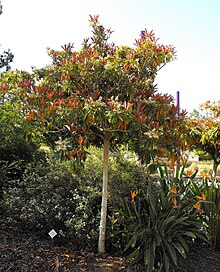
Eriobotrya deflexa

From Wikipedia, the free encyclopedia
Eriobotrya deflexa
Eriobotryadeflexa.jpg
Scientific classification
Kingdom:Plantae
(unranked):Angiosperms
(unranked):Eudicots
(unranked):Rosids
Order:Rosales
Family:Rosaceae
Genus:Eriobotrya
Species:E. deflexa
Binomial name
Eriobotrya deflexa
(Hemsl.Nakai
Synonyms[1][2]
  • Eriobotrya buisanensis (Hayata) Makino & Nemoto
  • Photinia buisanensis Hayata
  • Photinia deflexa Hemsl.
Eriobotrya deflexa is a tree native to GuangdongHainanTaiwan, and South Vietnam.[2]

Coppertone Loquat[edit]

The Coppertone Loquat (Eriobotrya x 'Coppertone') is a hybrid of Eriobotrya deflexa[3] and Indian Hawthorn (Rhaphiolepis indica)[4] and is a popular shrub in the Southern United States and California.

Eleutherine bulbosa dược liệu kháng HeLa (tế bào ung thư cổ tử cung)

Eleutherine bulbosa


From Wikipedia, the free encyclopedia
Eleutherine bulbosa
Eleutherine bulbosa Urb. (7304624248).jpg
Scientific classification
Kingdom:Plantae
(unranked):Angiosperms
(unranked):Monocots
Order:Asparagales
Family:Iridaceae
Subfamily:Iridoideae
Tribe:Tigridieae
Genus:Eleutherine
Herb.[1]
Species:E. bulbosa
Binomial name
Eleutherine bulbosa
(Mill.Urb.
Synonyms
  • Bermudiana bulbosa (Mill.) Molina
  • Bermudiana congesta (Klatt) Kuntze
  • Cipura plicata (Sw.) Griseb.
  • Eleutherine americana (Aubl.) Merr. ex K.Heyne
  • Eleutherine anomala Herb.
  • Eleutherine longifolia Gagnep.
  • Eleutherine plicata (Sw.) Herb.
  • Eleutherine plicata Herb. ex Klatt
  • Eleutherine subaphylla Gagnep.
  • Ferraria parviflora Salisb.
  • Galatea americana (Aubl.) Kuntze
  • Galatea bulbosa (Mill.) Britton
  • Galatea plicata (Sw.) Baker
  • Ixia americana Aubl.
  • Sisyrinchium americanum (Aubl.) Lemée
  • Sisyrinchium bulbosum Mill.
  • Sisyrinchium capitatum Pers.
  • Sisyrinchium congestum Klatt
  • Sisyrinchium elatum Seub. ex Klatt
  • Sisyrinchium latifolium Sw.
  • Sisyrinchium palmifolium var. congestum (Klatt) Baker
  • Sisyrinchium plicatum (Sw.) Spreng.
  • Sisyrinchium racemosum Pers.[2]
Eleutherine bulbosa is an herbaceousperennial flowering plant species in the iris family (Iridaceae). Among Spanish-speakers, the plant is known as lagrimas de la virgen ("tears of the virgin").[3]
Like other Eleutherine species, E. bulbosa has a bulbous rootstock; a large subapical cauline leaf; and small, white, stellate, evening-blooming flowersE. bulbosa grows in southern Mexico and in the Amazon rainforest, within the borders of Peru, Bolivia, Ecuador, Guyana, Suriname, and French Guiana, in addition to the Brazilian states of Amapá and Acre.[3] It is widely cultivated for its medicinal properties.
Like E. latifoliaE. bulbosa has a basic chromosome number of x=6 (2n=12); it also has a similar bimodal karyotype, which is distinctive to this plant tribe (Tigridieae); all other genera of the tribe have x=7. Usually, E. bulbosa has a heteromorphic long chromosome pair, the result of a pericentric inversion in one of the long chromosomes, which makes it sexually sterile.[4]
Rahenna described a subspecies in 1965: E. bulbosa subsp. citriodora.[5]

Eclipta prostrata dược liệu kháng HepG2 (tế bào ung thư gan)

MahakanniEclipta prostrata


(Redirigé depuis Eclipta prostrata)
image illustrant les Asteraceae (les Composées)
Cet article est une ébauche concernant les Asteraceae (les Composées).
Vous pouvez partager vos connaissances en l’améliorant (comment ?) selon les recommandations du projet botanique.
Le Mahakanni (Eclipta prostrata) est une plante herbacée à larges feuilles plates et à fleurs blanches de la famille des Asteraceae. Elle a la particularité de présenter des composants permettant, au contact de la peau d'obtenir un bronzage brun doré. Cette plante est utilisée dans certains laits autobronzants.

Synonyme[modifier | modifier le code]

  • Eclipta alba (L.) Hassk.


Eclipta prostrata

From Wikipedia, the free encyclopedia
Eclipta prostrata
Eclipta prostrata in AP W2 IMG 9785.jpg
Scientific classification
Kingdom:Plantae
(unranked):Angiosperms
(unranked):Eudicots
(unranked):Asterids
Order:Asterales
Family:Asteraceae
Genus:Eclipta
Species:E. prostrata
Binomial name
Eclipta prostrata
(L.L.[1]
Synonyms[2]
Eclipta prostrata commonly known as false daisyyerba de tago, and bhringraj, is a species of plant in the sunflower family. It is widespread across much of the world.[2][3][4][5]
Other common names include kehraj (কেঁহৰাজ)in Assamese and karisalaankanni (கரிசலாங்கண்ணி) in Tamil and kayyunni (കയ്യുന്നി) in Malayalam and 'माका' in Marathi.In {Kannada} Garugada soppu, keshavardhini, Bhringaraja
This plant has cylindrical, grayish roots. The solitary flower heads are 6–8 mm (0.24–0.31 in) in diameter, with white florets. The achenes are compressed and narrowly winged.

in KeralaIndia
This species grows commonly in moist places as a weed in warm temperate to tropical areas worldwide. It is widely distributed throughout IndiaNepal,[6] ChinaThailand, and Brazil.

Traditional uses[edit]


Flower of Eclipta prostrata - Macro Photography
The plant has traditional uses in Ayurveda. It is bitter, hot, sharp, dry in taste. In India it is known as bhangra (भांग्र), bhringarajbhrungraja and bhringrajaWedelia calendulacea is known by the same names, so the white-flowered E. alba is called white bhangra and the yellow-flowered W. calendulacea is called yellow bhangra.[7] The various Sanskrit names of Eclipta Alba, i.e. Bhringraj, Bhringraja, Bhrungraja etc., are literally translated as the 'King of Hair', clearly referring to its traditional reputation in Ayurveda as an herb supporting hair growth.[8] Some Ayurvedic hair oils incorporate Bhringraj as an ingredient.
It is reported to improve hair growth and color.[9][10][medical citation needed] A study in rats showed that petroleum ether extracts of E. prostrata decreased the amount of time it took for hair to begin regrowing and to fully regrow in shaved albino rats. The result of treatment with E. prostrata was better than the positive control, 2% minoxidil.[11][12][13]

Ayurveda[edit]


Seed of Eclipta prostrata closeup view
In the Ayurvedic System, Eclipta Alba, as with all other herbs, is classified according to its qualities, taste, physiological effects, etc. Ayurveda states that it is: Taste – Katu (Bitter), Tikta (Pungent) Quality – Rooksha (Dry), Laghu (light to digest) Energy - Ushna (Hot) Post Digestive Effect - Pungent, i.e. undergoes a pungent taste conversion after digestion. According to Ayurveda, these qualities characterize the medicinal effects of Eclipta Alba on the body, and are expressed in Ayurvedic terms as balancing for Kapha, i.e. balancing for the moist and unctuous tissues and anabolic systems of the body such as fats and fluids, and balancing for Vata, i.e. the nervous system and catabolic functions.

Chemistry[edit]