Vaccinium vitis-idaea (
lingonberry,
partridgeberry, or
cowberry) is a short
evergreen shrub in the
heath family that bears edible
fruit,
native to boreal forest and Arctic tundra throughout the Northern Hemisphere from Eurasia to North America. Lingonberries are picked in the wild and used to accompany a variety of dishes in Northern
Baltoscandia.
[2] Commercial cultivation is undertaken in the U.S. Pacific Northwest.
[3]
Vaccinium vitis-idaea is most commonly known in English as lingonberry or cowberry.
[4][5][6][7] The name lingonberry originates from the Swedish name
lingon for the species, and is derived from the Norse
lyngr, or heather.
There are at least 25 other common English names of
Vaccinium vitis-idaea worldwide, including:
[4]
- foxberry
- quailberry
- bearberry
- beaverberry
- mountain cranberry
- red whortleberry
|
- lowbush cranberry
- cougarberry
- mountain bilberry
- partridgeberry[12] (in Newfoundland and Cape Breton Island)
- redberry (in Labrador and the Lower North Shore of Quebec)
|
Description[edit]
Vaccinium vitis-idaea spreads by
underground stems to form dense
clonal colonies. Slender and brittle
roots grow from the underground stems. The stems are rounded in cross-section and grow from 10 to 40 cm (4 to 16 in) in height. Leaves grow
alternately and are oval, 5–30 mm (0.2–1.2 in) long, with a slightly wavy margin, and sometimes with a notched tip.
The
flowers are bell-shaped, white to pale pink, 3–8 mm (0.1–0.3 in) long, and produced in the early summer.
The fruit is a red
berry 6–10 mm (0.2–0.4 in) across, with an acidic taste, ripening in late summer to autumn.
[6][13]
Ecology[edit]
Vaccinium vitis-idaea keeps its leaves all winter even in the coldest years, unusual for a
broad-leaved plant, though in its natural habitat it is usually protected from severe cold by snow cover. It is extremely hardy, tolerating temperatures as low as −40 °C (−40 °F) or lower, but grows poorly where summers are hot. It prefers some shade (as from a forest canopy) and constantly moist,
acidic soil. Nutrient-poor soils are tolerated but not
alkaline soils.
Varieties[edit]
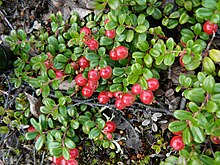
Vaccinium vitis-idaea var.
minus
There are two regional
varieties or
subspecies of
V. vitis-idaea, one in Eurasia and one in North America, differing in leaf size:
- V. vitis-idaea var. vitis-idaea L. — syn. V. vitis-idaea subsp. vitis-idaea.
Cowberry. Eurasia. Leaves 10–30 mm (0.4–1.2 in) long.[6]
- V. vitis-idaea var. minus Lodd. — syn. V. vitis-idaea subsp. minus (Lodd.) Hultén.
Lingonberry. North America. Leaves 5–18 mm (0.2–0.7 in) long.[13]
Cultivation[edit]
Culinary uses[edit]
The berries collected in the wild are a popular fruit in northern, central and eastern Europe, notably in Nordic countries, the Baltic states, central and northern Europe. In some areas, they can legally be picked on both public and private lands in accordance with the
freedom to roam.
[16]
The berries are quite tart, so they are often cooked and sweetened before eating in the form of
lingonberry jam, compote, juice, smoothie or syrup. The raw fruits are also frequently simply mashed with sugar, which preserves most of their nutrients and taste. This mix can be stored at room temperature in closed but not necessarily sealed containers, but in this condition, they are best preserved frozen. Fruit served this way or as compote often accompany game and liver dishes. In Sweden and Norway, reindeer and elk steak is traditionally served with gravy and lingonberry sauce. Preserved fruit is commonly eaten with meatballs, potato pancakes. A traditional Swedish dessert is
lingonpäron (literally lingonberry pears), consisting of fresh pears which are peeled, boiled and preserved in
lingondricka (lingonberry juice) and is commonly eaten during Christmas. This was very common in old times, because it was an easy and tasty way to preserve pears. In Sweden and Russia, when sugar was still a luxury item, the berries were usually preserved simply by putting them whole into bottles of water. This was known as
vattlingon (watered lingonberries); the procedure preserved them until next season. This was also a home remedy against
scurvy. This traditional Russian soft drink, known as "
lingonberry water", is mentioned by
Alexander Pushkin in
Eugene Onegin. In Russian
folk medicine, lingonberry water was used as a mild laxative. A traditional Finnish dish is
sautéed reindeer (
poronkäristys) with mashed potatoes and lingonberries, either cooked or raw with sugar. In Finland, a porridge made from the fruit is also popular. In Poland, the berries are often mixed with
pears to create a sauce served with poultry or game. The berries can also be used to replace redcurrants when creating
Cumberland sauce to give it a more sophisticated taste.

19th century illustration
The berries are also popular as a wild picked fruit in Eastern Canada, for example in Newfoundland and Labrador and Cape Breton, where they are locally known as partridgeberries or redberries, and on the mainland of Nova Scotia, where they are known as foxberries. In this region they are incorporated into jams, syrups, and baked goods, such as pies, scones, and muffins.
In Sweden lingonberries are often sold as jam and juice, and as a key ingredient in dishes. They are used to make Lillehammer berry liqueur; and, in East European countries, lingonberry
vodka is sold.
Nutritional properties[edit]
Traditional medicine[edit]
In folk medicine,
V. vitis-idaea has been used as an
apéritif,
astringent,
antihemorrhagic,
anti-debilitive,
depurative,
antiseptic(especially for the urethra), a
diuretic, a tonic for the
nervous system, and in various ways to treat
breast cancer,
diabetes mellitus,
rheumatism, and various
urogenital conditions.
[18] In traditional Austrian medicine the fruits have been administrated internally as jelly or syrup for treatment of disorders of the gastrointestinal tract, kidneys and urinary tract, and fever.
[19]
Related species[edit]
Vaccinium vitis-idaea differs from the related
cranberries in having white flowers with petals partially enclosing the stamens and stigma, rather than pink flowers with petals reflexed backwards, and rounder, less pear-shaped berries.




.jpg)


