Anti-proliferative effect of allicin on human hepatoma HepG2 cells.
Allicin hợp chất kháng HepG2
From Wikipedia, the free encyclopedia
Allicin

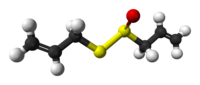
Names Preferred IUPAC name
S-Prop-2-en-1-yl prop-2-ene-1-sulfinothioate
Other names
2-Propene-1-sulfinothioic acid S-2-propenyl ester
3-[(Prop-2-ene-1-sulfinyl)sulfanyl]prop-1-ene
S-Allyl prop-2-ene-1-sulfinothioate
Identifiers
3D model (JSmol)
1752823 ChEBI
ChemSpider
ECHA InfoCard 100.007.935 EC Number 208-727-7
KEGG
MeSH Allicin
PubChem CID
UNII
Properties
C6H10OS2 Molar mass 162.26 g·mol−1 Appearance Colourless liquid Density 1.112 g cm−3 Melting point <25 °C Boiling point decomposes
Except where otherwise noted, data are given for materials in their standard state (at 25 °C [77 °F], 100 kPa).
 verify (what is
 ?)
?)Infobox references
Allicin is an organosulfur compound obtained from garlic, a species in the family Alliaceae.[1] It was first isolated and studied in the laboratory by Chester J. Cavallito and John Hays Bailey in 1944.[2][3] When fresh garlic is chopped or crushed, the enzyme alliinase converts alliin into allicin, which is responsible for the aroma of fresh garlic.[4] The allicin generated is unstable and quickly changes into a series of other sulfur-containing compounds such as diallyl disulfide.[5]Allicin is part of a defense mechanism against attacks by pests on the garlic plant.[6]
From Wikipedia, the free encyclopedia
 | |
 | |
| Names | |
|---|---|
| Preferred IUPAC name
S-Prop-2-en-1-yl prop-2-ene-1-sulfinothioate
| |
| Other names
2-Propene-1-sulfinothioic acid S-2-propenyl ester
3-[(Prop-2-ene-1-sulfinyl)sulfanyl]prop-1-ene S-Allyl prop-2-ene-1-sulfinothioate | |
| Identifiers | |
3D model (JSmol)
| |
| 1752823 | |
| ChEBI | |
| ChemSpider | |
| ECHA InfoCard | 100.007.935 |
| EC Number | 208-727-7 |
| KEGG | |
| MeSH | Allicin |
PubChem CID
| |
| UNII | |
| Properties | |
| C6H10OS2 | |
| Molar mass | 162.26 g·mol−1 |
| Appearance | Colourless liquid |
| Density | 1.112 g cm−3 |
| Melting point | <25 °C |
| Boiling point | decomposes |
Except where otherwise noted, data are given for materials in their standard state (at 25 °C [77 °F], 100 kPa).
| |
| verify (what is ?) | |
| Infobox references | |
Allicin is an organosulfur compound obtained from garlic, a species in the family Alliaceae.[1] It was first isolated and studied in the laboratory by Chester J. Cavallito and John Hays Bailey in 1944.[2][3] When fresh garlic is chopped or crushed, the enzyme alliinase converts alliin into allicin, which is responsible for the aroma of fresh garlic.[4] The allicin generated is unstable and quickly changes into a series of other sulfur-containing compounds such as diallyl disulfide.[5]Allicin is part of a defense mechanism against attacks by pests on the garlic plant.[6]
Contents
Structure and occurrence[edit]
Allicin features the thiosulfinate functional group, R-S(O)-S-R. The compound is not present in garlic unless tissue damage occurs,[1] and is formed by the action of the enzyme alliinase on alliin.[1] Allicin is chiral but occurs naturally only as a racemate.[3] The racemic form can also be generated by oxidation of diallyl disulfide:[7]
- (SCH2CH=CH2)2 + RCO3H → CH2=CHCH2S(O)SCH2CH=CH2 + RCO2H
Allicin features the thiosulfinate functional group, R-S(O)-S-R. The compound is not present in garlic unless tissue damage occurs,[1] and is formed by the action of the enzyme alliinase on alliin.[1] Allicin is chiral but occurs naturally only as a racemate.[3] The racemic form can also be generated by oxidation of diallyl disulfide:[7]
- (SCH2CH=CH2)2 + RCO3H → CH2=CHCH2S(O)SCH2CH=CH2 + RCO2H
Biosynthesis[edit]
Allicin is an oily, slightly yellow liquid that gives garlic its unique odor. It is a thioester of sulfenic acid and is also known as allyl thiosulfinate.[11] Its biological activity can be attributed to both its antioxidant activity and its reaction with thiol-containing proteins.[12]
In the biosynthesis of allicin (thio-2-propene-1-sulfinic acid S-allyl ester), cysteine is first converted into alliin (+ S-allyl-L-cysteine sulfoxide). The enzyme alliinase, which contains pyridoxal phosphate (PLP), cleaves alliin, generating allysulfenic acid, pyruvate, and ammonium.[12] At room temperature allysulfenic acid is unstable and highly reactive, which cause two molecules of it to spontaneously combine in a dehydration reaction to form allicin.[11]
Produced in garlic cells, allicin is released upon disruption, producing a potent characteristic scent when garlic is cut or cooked.[5][6]
Allicin is an oily, slightly yellow liquid that gives garlic its unique odor. It is a thioester of sulfenic acid and is also known as allyl thiosulfinate.[11] Its biological activity can be attributed to both its antioxidant activity and its reaction with thiol-containing proteins.[12]
In the biosynthesis of allicin (thio-2-propene-1-sulfinic acid S-allyl ester), cysteine is first converted into alliin (+ S-allyl-L-cysteine sulfoxide). The enzyme alliinase, which contains pyridoxal phosphate (PLP), cleaves alliin, generating allysulfenic acid, pyruvate, and ammonium.[12] At room temperature allysulfenic acid is unstable and highly reactive, which cause two molecules of it to spontaneously combine in a dehydration reaction to form allicin.[11]
Produced in garlic cells, allicin is released upon disruption, producing a potent characteristic scent when garlic is cut or cooked.[5][6]

Research[edit]
Allicin has been studied for its potential to treat various kinds of multiple drug resistance bacterial infections, as well as viral and fungal infections in vitro, but as of 2016, the safety and efficacy of allicin to treat infections in people was unclear.[13]
In a small clinical trial, a daily high dose of extracted allicin (20 times the amount in a garlic clove) showed effectiveness to prevent the common cold.[14] A Cochrane review found this to be not sufficient to draw conclusions.[15]
Allicin has been studied for its potential to treat various kinds of multiple drug resistance bacterial infections, as well as viral and fungal infections in vitro, but as of 2016, the safety and efficacy of allicin to treat infections in people was unclear.[13]
In a small clinical trial, a daily high dose of extracted allicin (20 times the amount in a garlic clove) showed effectiveness to prevent the common cold.[14] A Cochrane review found this to be not sufficient to draw conclusions.[15]
See also[edit]

Wikimedia Commons has media related to Allicin.
- Allyl isothiocyanate, the active piquant chemical in mustard, radishes, horseradish and wasabi
- syn-Propanethial-S-oxide, the chemical found in onions
- List of phytochemicals in food
| Wikimedia Commons has media related to Allicin. |
- Allyl isothiocyanate, the active piquant chemical in mustard, radishes, horseradish and wasabi
- syn-Propanethial-S-oxide, the chemical found in onions
- List of phytochemicals in food

No comments:
Post a Comment