- Arthrophyllum ceylanicum Miq.
- Arthrophyllum reticulatum Blume ex Miq.
- Bignonia indica L.
- Bignonia lugubris Salisb.
- Bignonia pentandra Lour.
- Bignonia quadripinnata Blanco
- Bignonia tripinnata Noronha
- Bignonia tuberculata Roxb. ex DC.
- Calosanthes indica (L.) Blume
- Hippoxylon indica (L.) Raf.
- Oroxylum flavum Rehder
- Oroxylum indicum Vent. nom. inval.[1]
- Spathodea indica (L.) Pers.
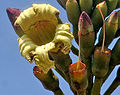
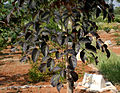
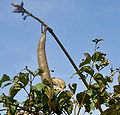


Oroxylum indicum-núc nác
From Wikipedia, the free encyclopedia
| Oroxylum indicum | |
|---|---|
 | |
| Plate from book Flora de Filipinas, Gran edicion, Atlas I. by Francisco Manuel Blanco, 1880-1883? where name is Bignonia quadripinnata, Blanco. | |
| Scientific classification | |
| Kingdom: | Plantae |
| (unranked): | Angiosperms |
| (unranked): | Eudicots |
| (unranked): | Asterids |
| Order: | Lamiales |
| Family: | Bignoniaceae |
| Genus: | Oroxylum |
| Species: | O. indicum |
| Binomial name | |
| Oroxylum indicum (L.) Benth. ex Kurz | |
| Synonyms[2] | |
Oroxylum indicum is a species of flowering plant belonging to the family Bignoniaceae, commonly called midnight horror,[3]oroxylum,[3] or Indian trumpet flower.[4] It is a tree which can reach a height of 12 metres (39 ft).
Description[edit]
The large leaf stalks wither and fall off the tree and collect near the base of the trunk, appearing to look like a pile of broken limb bones. The tree is a night-bloomer and flowers are adapted to natural pollination by bats. They form enormous seed pods that hang down from bare branches. Those long fruits curve downward and resemble the wings of a large bird or dangling sickles or swords in the night.
The seeds are round with papery wings.[5]
The seeds are round with papery wings.[5]
Distribution[edit]
Oroxylum indicum is native to the Indian subcontinent, in the Himalayan foothills with a part extending to Bhutan and southern China, in Indo-China and the Malesia ecozone.
It is visible in the forest biome of Manas National Park in Assam, India. It is found, raised and planted in large number in the forest areas of the Banswara district in the state of Rajasthan in India. It is reported in the list of rare, endangered and threatened plants of Kerala (South India).
It is also reported from Sri Lanka (Ceylon).[6]


Ecology[edit]
Oroxylum indicum lives in relationship with the actinomycete Pseudonocardia oroxyli present in the soil surrounding the roots.[7]
Septobasidium bogoriense is a fungal species responsible for velvet blight in O. indicum.
Uses[edit]
The tree is often grown as an ornamental for its strange appearance. Materials used include the wood, tannins and dyestuffs.
In marriage rituals[edit]
The plant is used by the Kirat, Sunuwar, Rai, Limbu, Yakha in Nepal, the Thai in Thailand and the Lao in Laos.
In the Himalayas, people are hanging mobiles or garlands made from O. indicum (Skr. shyonaka) seeds from the roof of their homes for protective reasons.[8]
As food[edit]
It is a plant with edible leaves and stems.[9] The very large young pods, known as Lin mai (ลิ้นไม้) or Lin fa (ลิ้นฟ้า) in Loei, are eaten especially in Isan (Thailand) and in Laos. They are first grilled over charcoal fire and then the somewhat bitter inner pulp is usually scraped and eaten along with lap.[10]
In traditional medicines[edit]
The Oroxylum indicum seed is used in the traditional Indian ayurvedic medicine.
Shyonaka root bark is one of the ingredients of dashamoola (a group of 10 roots). It is used for its anti-inflammatory and analgesic action in a number of compound formulations in Ayurveda.[11]
The bark of O. indicum is a traditional Chinese medicine ingredient, as well as is one of main ingredients in Sri Lankan indigenous medicine in decoctions as a remedy for pains in joints or rheumatism (Singhala / Sri Lanka: Totila, Totilla).[12]
Pharmacology[edit]
The leaf contains chrysin and baicalein.[13] Tetuin, the 6-glucoside of baicalein, is reported in the seeds.[14] Other flavonoids, known for their anti-inflammatory and anti-allergy effects,[citation needed] are also present, though it may need to be used in high doses to get a response. Oroxindin has also been isolated from Oroxylum indicum[15] whereas oroxylin A is reported in the root bark.[16]

No comments:
Post a Comment